

discourse of bronnbach
thinking in advance
This series of events organised by the Wittenstein Foundation creates a forum for interdisciplinary dialogue between innovative research and relevant practice – with representatives from various organisations in the Main-Tauber region, but also from other related fields of experience.
In practical references and case studies, different areas of reality (technology, economy, politics, culture, society, administration...) are discussed across the events. Insights, suggestions and dialogues take place not only between science and practice, but are also facilitated between practice and practice. Particular attention is paid to unusual empirical relationships that only become apparent at second glance.
The use of Bronnbach Monastery as an extraordinary place of reflection is part of a wider range of activities relating to the future prospects of the Main-Tauber district.
fourth event
beyond utopia?


As part of the 43rd Baden-Württemberg Literature Days, a panel discussion featuring a distinguished line-up took place on Wednesday 30 September 2026 at Bronnbach Monastery under the title “Beyond Utopia? Thinking about and shaping the future nonetheless”.
The world is creaking at the seams: wars, climate change, economic crisis, crumbling democracies – it feels as though everyone is simply hoping that a major catastrophe will not occur. But paralysis is no help at all, and so the panel, as part of the Bronnbach Discourse series, discussed how the future can be imagined and shaped today.
What remains from an evening spent discussing the future?
Perhaps, above all, the realisation that the future does not emerge because we know all the answers. Rather, it emerges because we are prepared to endure questions, bring together different perspectives and take responsibility.
In the historic setting of Bronnbach Monastery, participants reflected on how we can shape the future in a time of great change. The discussion went beyond crises and uncertainties to cover education, cooperation, technology, human dignity – and the question of what kind of future we actually want.
Our guests: philosopher and former Minister of State for Culture Julian Nida-Rümelin, who, in his latest book *Der Epochenbruch* (*The Break with the Past*), asks whether we are on the path to a new world order. Also Sabria David, a German digital philosopher, author, blogger and lecturer. She writes from a cultural-philosophical perspective on the impacts and potential of digital transformation on society, the media and work. And Martina Klärle, President of the Baden-Württemberg Cooperative State University, demonstrates in *Die kleine große Transformation* how the energy transition and climate adaptation can succeed. Gert Scobel, a long-standing presenter on 3sat, hosted the evening.
third event
evolutionary principles
in business and organisation


On 21 May 2026, the third event in the Wittenstein Foundation’s “Discourse of Bronnbach” series took place. Representatives from WITTENSTEIN SE, LEOspace GmbH, attocube systems GmbH and the Wittenstein Foundation gathered at Bronnbach Monastery to discuss the applicability of evolutionary processes to organisational and economic processes using an ecosystem-based approach.
The speakers, Dr Klaus-Stephan Otto (EVOCO GmbH) and Prof. Dr Oliver Schwarz (Fraunhofer IPA), demonstrated how companies and society can learn from successful processes and solutions that have emerged in the history of evolution in nature.
second event
"stem are some subjects"


On November 28, 2025, the Wittenstein Foundation held the second event in its “Discourse of Bronnbach” series. Representatives from science, business, and education gathered at Bronnbach Monastery to discuss key new findings on STEM motivation among young people in the Main-Tauber region. The discussion was based on preliminary findings from the DynaMINT research project conducted by the MIND Center at the University of Würzburg, which is being funded by the Wittenstein Foundation with one million euros over a period of five years and will run until 2028.
Read here the press release.
first event
stem - why not?


Our new series of events kicked off on 19 November 2024. 12 regional representatives from science, business, politics and education discussed the topic of STEM in the Main-Tauber region, based on the ongoing research work of the MIND Centre Würzburg.
Participants:
-
Agnes Birner, PhD student MIND Centre Würzburg
-
Florian Frank, PhD student MIND Centre Würzburg
-
Dr Markus Elsholz, Managing Director MIND Centre Würzburg
-
Heiko Knebel, Managing Principal Bad Mergentheim
-
Iris Lange-Schmalz, MINT-Region Main-Tauber e.V.
-
Prof. Dr Kim Linsenmayer, Head of DHBW Campus Bad Mergentheim
-
Prof. Dr Eckard Minx, Deputy Chairman of the Board of Trustees
-
Ursula Mühleck, Head of District Development and Education Main-Tauber-Kreis
-
Dr Gunther Schunk, Chairman of the Board Vogel Stiftung Dr Eckernkamp
-
Dr Sascha von Berchem, Managing Director
-
Dr Anna-Katharina Wittenstein, Member of the Board of Trustees
-
Dr Manfred Wittenstein, Chairman of the Board of Trustees
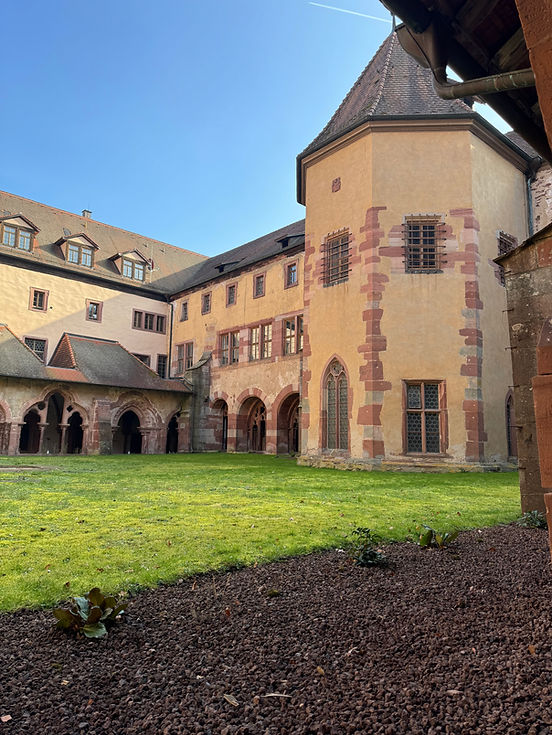
Bronnbach Monastery is a former Cistercian abbey founded in 1151. In 1986, the Main-Tauber district acquired the monastery and had it renovated in several construction phases. The individual monastery buildings were gradually put to a new use while preserving the overall historical ensemble, and Bronnbach Monastery developed into a culturally diverse and revitalised centre.
Thematic change of focus from event to event
For the discourse of Bronnbach, the monastery provides the perfect backdrop for discussing fundamental questions about the "where to" of the region. These questions relate equally to socio-political, social, economic and technological challenges and potentials of the near and medium future. The latter against the background of the generally dynamic developments in technology and the economy, as well as the associated planetary challenges.